How to Choose a Self Storage Facility in Dubai
Choose a self storage facility in Dubai by comparing security, access, climate control, location, pricing and unit suitability.
When choosing a self storage facility in Dubai, prioritise security and access control first, followed by climate control and location. Price, contract flexibility, cleanliness, pest control, and unit suitability should then be compared before making a final decision.
Choosing a storage facility is not simply about finding the cheapest available unit. The facility itself matters because customers are trusting the provider with furniture, documents, inventory, equipment, and personal belongings. A suitable facility should match the type of items being stored, how often they need to be accessed, and how long the storage is likely to be required.
Dubai has a wide range of self storage facilities, and the differences between providers can include access arrangements, security systems, storage conditions, location, contract terms, and facility maintenance. Comparing these criteria consistently makes it easier to distinguish between providers instead of making a decision based only on an advertised monthly price.
How do you choose a self storage facility in Dubai?
Start by identifying what you need to store, how often you need access, and how long you expect to rent the space. These three points provide a practical starting point for comparing storage facilities in Dubai.
For example, someone storing furniture during a six-month renovation may place more importance on security, climate conditions, and access than someone storing a few boxes for a short period.
A business may have different priorities. It may need regular access to inventory, convenient loading arrangements, flexible rental terms, and enough space to accommodate changing stock levels.
The best facility is therefore not necessarily the cheapest or closest one. It is the facility that provides the right combination of storage conditions, access, security, location, and rental terms for the items being stored.
What are the most important criteria for choosing a storage facility?
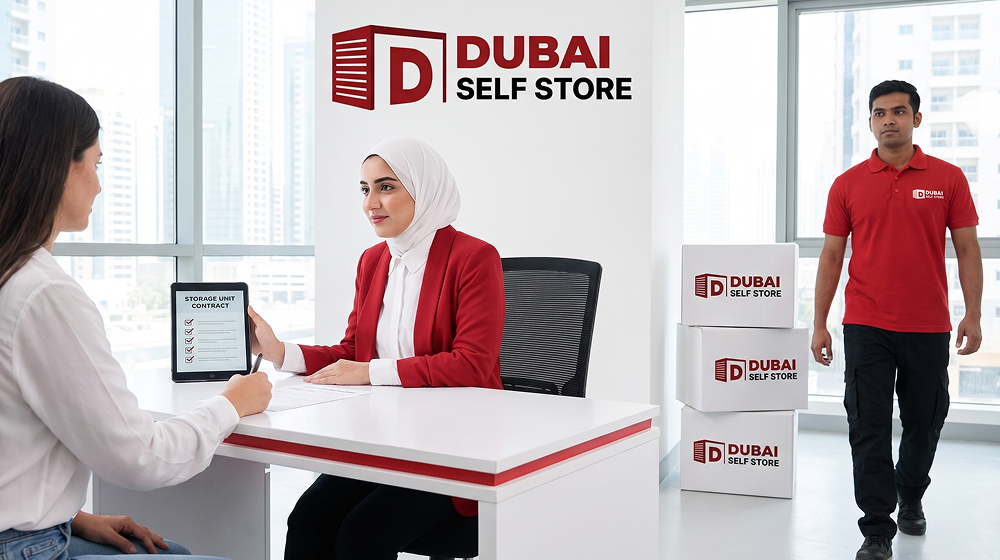
A storage facility can be assessed using several practical criteria. Security and access control should receive the highest priority because they determine who can enter the facility and reach stored belongings. Climate control is particularly important for heat- or humidity-sensitive items, while location becomes more important when frequent access is required.
The following weighting can be used as a practical comparison framework:
| Selection criterion | Suggested weighting | What to compare |
|---|---|---|
| Security and access control | 30% | Entry controls, monitoring, unit access, and security procedures |
| Climate control | 20% | Temperature and humidity conditions for sensitive belongings |
| Location and distance | 15% | Travel time, accessibility, and convenience |
| Price and contract flexibility | 15% | Monthly cost, rental period, deposits, and notice terms |
| Cleanliness and pest control | 10% | Facility condition, housekeeping, and pest-management practices |
| Unit size and suitability | 10% | Available space and whether the unit matches your belongings |
These percentages are a comparison framework, not a universal industry standard. The weighting can change depending on what is being stored and how often the unit will be accessed.
Security and access control
Security should be one of the first things to assess when comparing self storage facilities in Dubai.
Look for controlled entry to the facility, appropriate monitoring, and a clear process for controlling access to individual storage areas. Ask how customers enter the facility and whether access is restricted to authorised users or recorded through an access system.
Access arrangements also differ between facilities. Some may provide extended or 24-hour access, while others operate during specific hours. The more frequently you expect to visit the unit, the more important these access terms become.
A business that needs to retrieve inventory regularly, for example, has different access requirements from someone storing furniture that may remain untouched for several months.
Security and access should therefore be assessed together rather than treating them as separate features. A facility can have strong security controls but still be unsuitable if its access hours do not match the renter’s needs.
Climate control
Dubai’s climate makes storage conditions an important consideration for certain belongings.
Climate-controlled storage is designed to provide more controlled temperature and humidity conditions than standard storage environments. This can be particularly relevant for materials such as wood, leather, paper, electronics, artwork, and some fabrics that may be more sensitive to heat or humidity.
Not every customer necessarily needs climate-controlled storage. The decision depends on the type of belongings being stored and the conditions offered by the facility.
Customers comparing facilities should ask whether climate control is available, what areas of the facility are controlled, and whether it is included in the quoted rental price or charged separately.
Location and distance
Location affects both convenience and the practical cost of using a storage facility.
If you expect to visit the unit frequently, a facility that is easier to reach may be worth paying more for. If the belongings will remain stored for several months without access, distance may have less importance.
Consider the journey from your home, office, or business location and whether the facility is reasonably accessible for the type of vehicle being used to transport belongings.
For businesses, location can be especially important when inventory needs to move regularly between the storage facility and the workplace or customers.
A facility that is slightly farther away may still be the better choice if it offers substantially better storage conditions or contract terms.
Price and contract flexibility
Price matters, but the advertised monthly rate should not be the only figure used to compare facilities.
Check what is included in the rental price and whether there are additional charges for deposits, access, moving services, insurance, or other services. The rental period and notice requirements should also be clear before signing.
Contract flexibility is particularly relevant for customers whose storage period may change. A short-term renter may not want the same commitment as a business that expects to store inventory for a year or longer.
A cheaper unit may not represent better value if it has unsuitable access conditions or additional charges for services you actually need.
Cleanliness and pest control
A storage facility should be clean, organised, and properly maintained.
When visiting a facility, look at the condition of corridors, floors, doors, loading areas, and common spaces. Ask how routine cleaning is handled and whether the provider has a regular pest-control process.
This is particularly relevant when storing furniture, textiles, paper records, or business materials that could be affected by poor facility conditions.
Cleanliness is not simply an aesthetic issue. It can provide an indication of how consistently the facility is maintained and managed.
How do you check a facility’s licence and compliance?
Before renting a storage unit, customers can ask the provider for details about its business registration, relevant facility approvals, and applicable safety or regulatory requirements.
Do not rely only on a website statement or verbal assurance. Ask which authority issued the relevant approval, what the approval covers, and whether supporting documentation can be provided.
If a provider mentions DCD, SIRA, ISO, or another form of compliance, customers should ask for the applicable certificate, approval, or documentation rather than assuming that a general compliance statement covers every aspect of the storage operation.
It is also useful to distinguish between a security feature and a regulatory approval. For example, having CCTV or electronic access control is a facility feature; holding a particular licence or certification is a separate matter that should be verified through the relevant documentation.
Where a specific licence or approval cannot be independently verified, it is better to ask the provider directly than to assume that the facility holds it.
How do you match the unit size to your belongings?
The storage unit should be large enough to hold your belongings without paying for substantial unused space.
Start by estimating the total volume of furniture, boxes, equipment, or inventory you intend to store. Consider the dimensions of larger items as well as the number of boxes because two customers with the same number of items may require very different amounts of storage space.
A standard one-bedroom apartment, for example, may require considerably less space than a larger villa containing multiple rooms of furniture. Business requirements can also change according to inventory levels and seasonal demand.
The way items will be arranged matters too. A unit packed tightly from floor to ceiling may technically fit everything but make individual items difficult to retrieve. For this reason, allow enough room for practical access when estimating the required unit size.
What questions should you ask before signing?
Before signing a storage agreement, customers should clarify the practical terms of using the facility. The goal is to understand the full arrangement before committing, rather than discovering important conditions after the rental begins.
At minimum, ask:
- What is the total monthly rental cost?
- Are there deposits or additional charges?
- What are the facility and unit access hours?
- How is access controlled?
- Can someone else access the unit on my behalf?
- What is the notice period for ending the rental?
- Are there restrictions on the items I can store?
- Is climate-controlled storage available if required?
- What security systems are used at the facility?
- Can I change to a larger or smaller unit later?
These questions make it easier to compare providers on the same basis and identify terms that may affect the actual cost or convenience of the storage service.
Is a cheaper or a closer facility better in Dubai?
Neither is automatically better. The right choice depends on how the storage facility will be used.
A cheaper facility may make sense when belongings will remain stored for a long period and rarely need to be accessed. A closer facility may be more valuable when customers regularly collect stock, retrieve furniture, or visit the unit.
The same principle applies to security and climate control. Paying slightly more may be reasonable when belongings are valuable or sensitive, while a simpler facility may be sufficient for items that are less affected by temperature, humidity, or frequent handling.
For businesses, the calculation can be different again. A facility that is closer to the business may reduce travel time for repeated inventory trips, even if its monthly rental price is slightly higher.
The most useful comparison is therefore overall value rather than headline price or distance alone.
Choosing the Right Self Storage Facility
Choosing a self storage facility in Dubai becomes easier when every provider is assessed against the same criteria.
Start with security and access control, then consider climate control and location. After that, compare price, contract flexibility, cleanliness, pest control, and unit suitability.
The type of belongings also matters. Furniture, business inventory, documents, electronics, and other sensitive items can have different storage requirements.
Once you have narrowed down your options, review the available unit sizes, pricing, access conditions, and security features before making the final decision.
Storage price, unit size, and security each require their own level of consideration. The key is to compare facilities based on how well they meet your actual storage requirements, not simply on the lowest advertised rate.